
Who vouches for the accuracy of the content?
You do. Whatever the AI drafts from your material stays a draft until a curator or educator has read it and marked it verified. Every AI run is logged, separately for your institution.
For museums and heritage sites
Catalogues, monographs and guides hold expert knowledge that rarely reaches visitors. Turn it into activities that help adults, families and groups with a leader learn and remember what they saw: written by your team, drafted by AI, or both. Visitors see only what a curator has approved.
Examples
You have
The catalogue of a temporary exhibition, as a PDF.
You get
Info cards on the key exhibits, a quiz and matching pairs for adults, and a jigsaw and a colouring book for children, in the languages your visitors speak.
You have
A guide to the permanent display and photographs of the objects.
You get
A treasure hunt through the rooms, “Find in the picture” for details on the objects, and an ordering activity that walks visitors through the chronology.
You have
A curator who would rather write every question personally.
You get
Info cards and a quiz built by hand, activity by activity, with photographs from the museum’s own collection. The AI only translates them.
These examples are illustrative and are not client case studies.
Try an example
A small collection of everyday objects: what they were for, what they were made of and how a kitchen once worked.
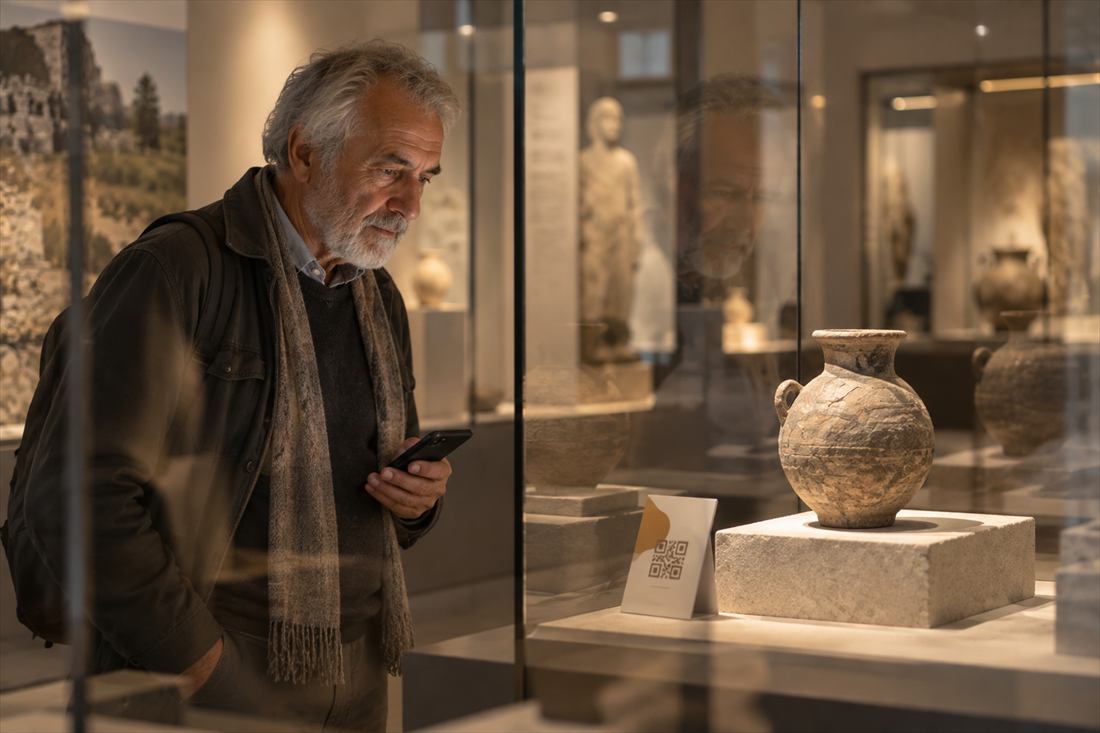
Scan the code with your phone or open the example directly. This is how it looks on a phone: in the browser, with no app to install.
We made these examples for demonstration. The institutions in them are invented and are not our clients.

Questions
You do. Whatever the AI drafts from your material stays a draft until a curator or educator has read it and marked it verified. Every AI run is logged, separately for your institution.
Yes. Every kind of activity can be built by hand from a blank page: your questions, your pictures, your order. You need the AI only for other languages or for narration.
Every unit comes with a draft printable guide for group leaders, with the answers, on your institution’s letterhead, alongside guides for children, teenagers and adults.
The Institution plan is agreed by contract: a signed data processing agreement, payment by invoice or purchase order, and an onboarding session for your team.
Your content is yours on every plan, and exporting raw content, media and JSON is free. With the Institution plan, a verified unit can also be exported as a static web package: a copy you host yourself, on your own server.
You choose the activities, so a museum can keep to info cards, quizzes and ordering and leave the colouring book out. Visitors see your colours, and the Institution plan shows no “Made with Aristoqle” badge.
Languages, narration, your colours and visitor privacy work the same for everyone:
Which plan
Museums and heritage sites usually work on the Institution plan: an annual contract for one institution, with no limit on published units or team members, payment by invoice and a signed data processing agreement.
No time to build it yourselves? We can write and illustrate it for you, from your material. Made to measure